Posts

Greta Thunberg (15 years old) is My New Hero

Image
Greta Thunberg attended the Jan 2019 World Economic Forum at Davos and, in front of the world's most influential and powerful people, she said,  "Now is the time to speak clearly. Solving the climate crisis is the greatest and most complex challenge that Homo Sapiens has ever faced.   "The main solution, however, is so simple that even a small child can understand it.  We have to stop the emissions of greenhouse gases.  And either we do that or we don't.   "You say nothing in life is black or white but that is a lie; a very dangerous lie.  Either we prevent 1.5 degrees of warming or we don't.  Either we avoid setting off that irreversible chain reaction beyond human control or we don't.  Either we choose to go on as a civilisation or we don't.  That is as black and white as it gets.   "We must change almost everything in our current societies.  The bigger your carbon footprint is, the bigger your moral duty...

Nominal Bracing Capacity of Plasterboard Walls is Conservative (maybe)

Image
In my last blog post I noted that full-scale testing by the Cyclone Testing Station (CTS) in Townsville had revealed that about 40% of the lateral load on a building is resisted by the plasterboard sheathing and cornices (Satheeskumar et al. , 2016).  As surprising as this might seem, it really shouldn't be at all surprising to structural engineers.  We know that architectural finishes add to the stiffness of a building.  This fact is clear from the dynamic behaviour of a finished building where the measured natural frequency of the building is almost always higher than the predicted natural frequency from software models ( i.e. , SpaceGASS, Etabs, Strand7, etc.), which typically neglect the non-structural elements. As part of my research, I am developing a suite of finite element (FE) models of mid-rise timber buildings (4 - 10 storeys) in order to predict the loading profile on the shear walls under earthquake and cyclonic loading conditions.  This will help ...

Testing Shear Walls for Cyclone Resistance

Image
Structural engineers design buildings to safely resist gravity loads (vertical loads), such as the self-weight of the building and the weight of people and furniture, as well as loads from extremely rare events, such as earthquakes and cyclones (lateral loads - image below).  Gravity loads are transferred down through the building to the foundations via beams, columns and load-bearing walls.  Lateral loads are transferred through the structure via a series of interconnected horizontal diaphragms (roof and suspended floors) and vertical shear walls (see image above). Over the next few years I will be developing and testing shear wall systems for tall timber buildings, so I am interested in finding the best methods for laboratory testing of timber shear walls.  My early research on this topic has uncovered some practices which I find odd. In an ideal world we would construct shear wall prototypes to match practices on building sites and then test them under c...

How green is my car?

Image
UPDATE (02/10/2018) - Updated to account for upstream CO2e emissions of fuel (i.e., extraction, refinement, and transport). A few years ago, my wife and I decided that our next car purchase would be an electric vehicle (EV).  We saw three reasons to make this decision: EVs have lower life-cycle greenhouse gas (GHG) emissions compared to petrol or diesel cars; An EV can be charged directly from our solar panels at minimal cost; and We believe that EVs are the future of personal transport and we wanted to be a part of the transition away from cars that burned fossil fuels, even if that meant that we would be paying more money up front to buy electric. A year later, we bought a fully electric Nissan Leaf.  The car has no exhaust pipe and we plug it into a powerpoint in our garage.  The car is a dream to drive.  It is so quiet, but also very quick. People seem to be interested in the car and the most common question is, "What is the range?"  We o...

Book Review: "From Bacteria to Bach and Back" Dan Dennett

Image
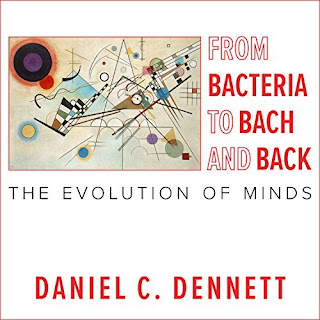
This is a book that takes some time to digest.  I've been reading it in short spurts over many months, allowing the deep subject matter to stew in my mind.  Dan Dennett is a Professor of Philosophy at Tufts University and he has spent his very long career seeking to explain, among other things, how the brain produces mind.  Dan's approach to this question is quite interesting.  He insists on using scientific findings to direct his thinking and he avoids metaphysical prognostication. There is a school of thought in "philosophy of mind" studies that there exists a so called hard problem of consciousness.  The hard problem of consciousness was described by Prof David Chalmers, an Australian philosopher at ANU, as the subjective experience of awareness that transcends the physical.  Chalmers uses the label   qualia  to describe this subjective feeling that arises in our minds when we experience the world.  He believes the nature of qualia ...

Because of Her We Can

Image
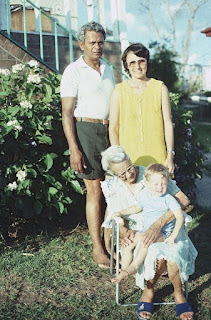
That's my great Nanna, Amy Ridgeway, holding onto me in the chair as I squint into the sun.  My Poppy, Les Ridgeway, is standing next to my mum, Cheryl, who is dressed in that lovely yellow 70's summer dress.  Everyone I've ever spoken to about Nanna Amy has said she was a beautiful person, loving, kind, and generous.  I remember Nanna Amy and the house she lived in.  Was it Newcastle?  I remember mum and Aunty Min caring for all us kids.  I remember having fun with Aunty Sandra's kids, mostly Brad and Michael because they were close to my age.  I remember eating ice blocks at Nanna Amy's house and watching TV. Nanna Amy was born 110 years ago at Salt Ash near Port Stephens to Laura Maher, who would have been 19 years old at the time.  Laura worked as a housekeeper for an Englishman named Henry Waddingham who owned a shipping company based at Windi Woppa.  He never officially recognised the children he fathered with Laura, although my g...

Taller Timber Buildings

Image
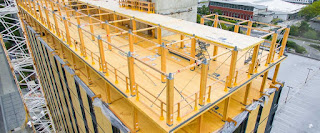
I have had a long fascination with tall buildings. Whenever I hear about a new building project, the one statistic I really want to know is how many storeys high the building is. On some deep level I am awed by the extent to which the engineer has beaten gravity. People were amazed and just a bit scared by the first concrete and steel skyscrapers that were built over 100 years ago.  I suppose there was a fear that they might collapse under their own weight.  It's a good thing that structural engineers know what they are doing, because almost nobody worries about skyscrapers collapsing any longer. Reinforced concrete (and some steel) skyscrapers have become the norm in cities all around the world, but they are now being challenged by the oldest engineering material known to humankind, WOOD ! The tallest timber building in the world at the moment is known as Brock Commons.  It is 18 storeys and located in Vancouver (see above and below).  The lift cores of th...